 CarbX
CarbXA Dilemma
Most economies depend on hard-to-abate industries.
EmitCos face complex decisions about when to invest in the transition, whether carbon capture, removals, sustainable fuels, or the infrastructure behind them. Before committing capital, they must anticipate future costs, carbon prices, technology curves, tariffs, and their timing.
Delaying only increases financial and reputational risk.
Rising Cost of Inaction
Currently, emissions liabilities are growing faster than the supply of financed transition projects capable of reducing them. This creates increasing exposure for both regulated EmitCos and companies pursuing voluntary decarbonisation objectives. Compliance-cost reduction is a strategic choice, not just technology selection.
The EU illustrates the trajectory. Under the EU ETS, free allowances phase out by 2034, and forecasts suggest allowance prices could reach €150 to €200 per tonne by 2035. Every year of delay makes compliance more expensive.
These costs are not just rising, they are uncertain. Every transition project is a gamble on future regulation and carbon prices. Hedging turns that gamble into strategy: EmitCos can price uncertainty rather than absorb it, and adjust their compliance position as conditions change.
Liability, Hedging and Supply Activation
Every tonne of emissions creates a liability. For regulated companies, that liability is imposed by law through compliance systems. For unregulated companies, it increasingly arises through investor expectations, supply chain requirements, net-zero commitments, and market pressures. The challenge for both is the same: how to manage an obligation that grows over time while the supply of mitigation remains constrained.
Compliance technologies such as CCS can reduce emissions and therefore reduce compliance obligations, but they cannot remove all future exposure. Residual emissions, operational underperformance, tightening regulation, and changing market conditions mean liabilities continue to exist and can continue to grow. Compliance pathways are therefore liability-reduction mechanisms, not liability-elimination mechanisms.
Illustrative example for CCS pathways
Residual Liabilities Must Be Hedged
Because liabilities persist into the future, companies require hedging strategies to protect themselves against rising compliance costs and tightening regulations. The most robust hedge is a future claim on mitigation supply that remains valid under increasingly stringent climate rules. CDRs are emerging as the primary hedging asset because they directly neutralise residual emissions and are increasingly recognised as the ultimate form of liability settlement.
CDRs alone will not be available in sufficient quantities to satisfy future demand. Companies will therefore need portfolios of contingent instruments, including compliance-linked options, CCS performance contracts, methane reduction instruments, and other future mitigation assets. These instruments hedge different elements of liability, while together creating the flexibility needed to manage long-term exposure.
Illustrative example for CCS pathways
Inelastic Compliance Demand increases Liability
Carbon liabilities exist within markets where demand is driven by regulation rather than choice. Regulated emitters must comply regardless of price, while mitigation supply remains slow to develop because it depends on financing, project development, and verification. This combination of inelastic demand and constrained supply creates structural scarcity, rising prices, and increasing liabilities unless new mitigation projects are activated.
And voluntary and compliance markets are converging around liability. The distinction between the two is beginning to disappear. Regulated companies buy mitigation because they must comply with legal obligations; voluntary companies increasingly buy mitigation because they recognise emissions as a financial, reputational, or strategic liability. Both groups are seeking the same outcome: access to future mitigation supply capable of reducing or extinguishing their liabilities.
Supply is prevented from satisfying Demand
Capital constraints are preventing Energy Transition projects being developed. Excluding renewable energy, many sectors within the Energy Transition such as biochar, DAC, BECCs and CCS are lacking commercial and/or technological maturity. That lack of maturity means that many projects do not yet meet the criteria for conventional finance to support their development. Consequently, despite strong demand for carbon removal- and replacement projects, supply cannot and will not satisfy it and costs for EmitCos and by extension consumers will continue to rise.
CarbX resolves this problem through Activation Finance which provides a series of instruments that allow early stage Energy Transition projects to be financed with an instrument, a Conto or derivative thereof, that can be applied to all Energy Transition projects and is structured to align with the development phases of a project, allowing the project to develop to the point where it can access conventional finance.
Pricing Compliance Liability with Contingent Options
A Conto (Contingent Option) is priceable by linking it to a future stage of a project which has a strong likelihood of being achieved because the previous stage has been completed and risk reduced. The future stage is a work programme to further reduce risk. Contos become tradable where past progress creates confidence; the degree of confidence makes the next stage definable, and the defined stage makes the option priceable. Future project stages become tradable commitments, allowing new projects to form as soon as each stage becomes credible.
Progress reduces risk, and Contos make the next stage priceable, bringing investors into the market. The staged structure accelerates development by unlocking funding when the work programme earns it. More stages become priceable, and liquidity builds around future commitments.
Contos activate Project Development
ActivationOps and CoTradEx are central to the CarbX strategy. ActivationOps creates standardised, verified Contos and is CarbX's supply-side engine. CoTradEx creates the market through which those instruments can be exchanged and is the market-side engine. Together, these are the two components of Activation Finance: one builds activation capacity and the other commercialises activation instruments. Together they establish a continuous capital formation cycle. This structure increases the liquidity of development capital, improves capital efficiency and accelerates the delivery of energy transition infrastructure at scale.
ActivationOps creates the project and financing structures that enable future project value to be recognised, verified and financed during development. CoTradEx provides the marketplace where qualified project instruments can be traded, enabling liquidity, price discovery and broader investor participation.
CoTradEx Becomes a Vital Market
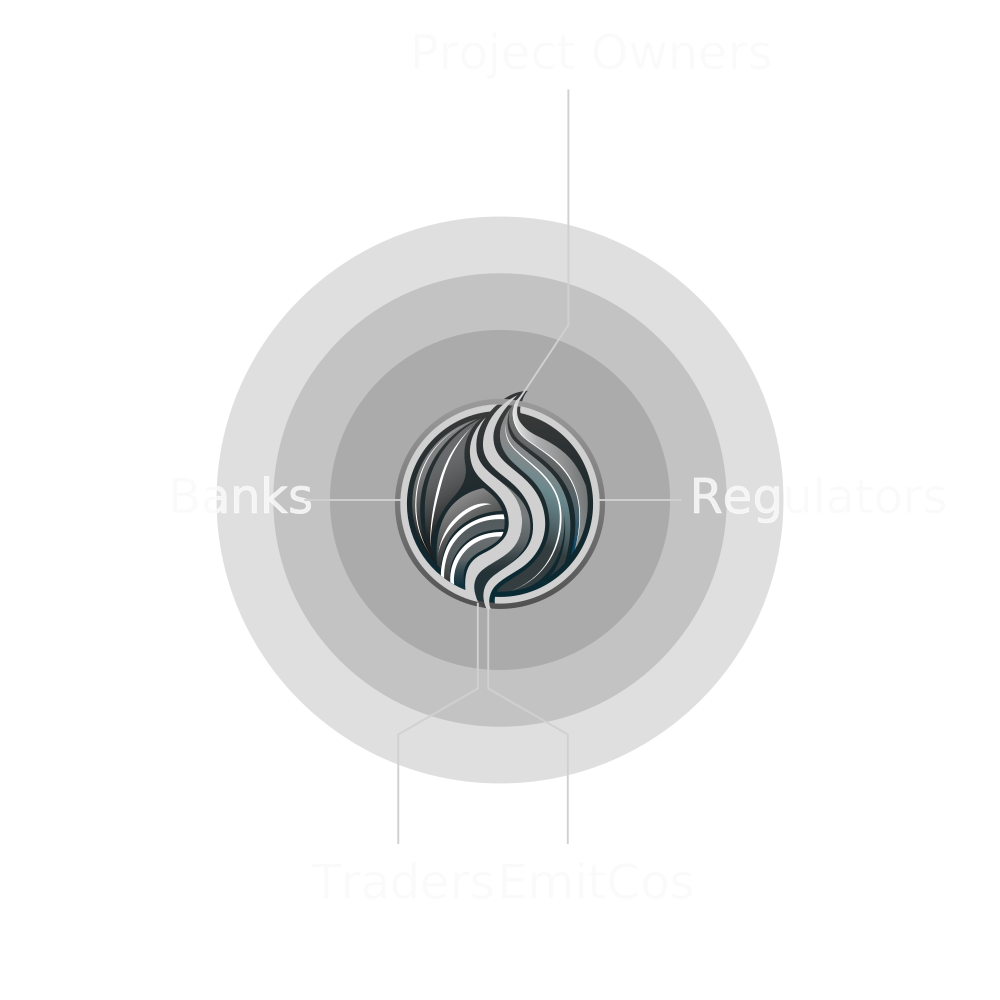
Contingent Options attract new participants into the market because investors can back specific future stages rather than committing to an entire project and its delivery risk. CoTradEx becomes vital because it creates a shared hedging architecture in which EmitCos, investors, lenders, and insurers all stabilise one another's risk positions. Contingent Options allow EmitCos to hedge compliance-cost volatility, but their real power is that they also give the wider capital stack a way to hedge delivery, credit, construction, and operational risk.
These risks are different, yet tightly coupled. When EmitCos hedge compliance exposure, they create predictable demand signals that investors can rely on; when investors hedge project performance exposure, they create delivery signals that lenders can rely upon. Thus, when EmitCos purchase Contingent Options, such purchases will be supported and amplified by those from other parties.
Accelerating Energy Transition
The energy transition is not primarily constrained by technology. It is constrained by the inability of markets to price future transition risk and direct capital into the projects needed to reduce that risk.
Emissions create liabilities. Liabilities create demand for hedging. Hedging requires future mitigation capacity. Future mitigation capacity requires project finance.
CarbX exists to connect these elements into a functioning market.